Interpretation of 2023 CSCO Prostate cancer guidelines update features
With the continuous improvement and development of prostate cancer diagnosis and treatment at home and abroad, the clinical experience based on evidence-based medicine has been widely promoted. In order to continuously improve the survival outcome of prostate cancer patients in China, the CSCO Prostate Cancer Special Committee released the 2023 edition of the CSCO Prostate Cancer Diagnosis and Treatment Guidelines in June this year, and many prostate cancer experts gathered to witness the update of the guidelines. This article will take you to see the 2023 edition of the CSCO Prostate Cancer Treatment Guide updated what content!
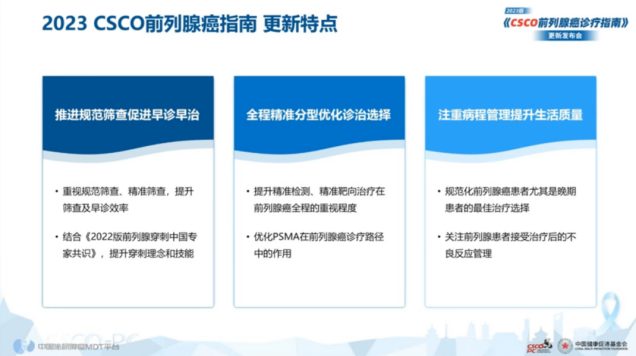
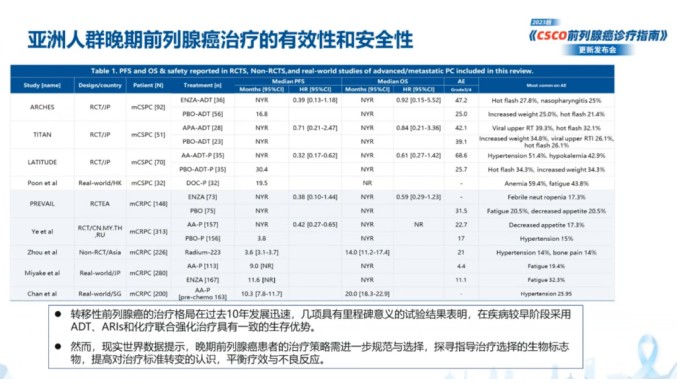
Professor Zhu Yao, Secretary-General of the Committee, was the first to point out that the characteristics of the 2023 CSCO prostate cancer guidelines are mainly reflected in promoting standardized screening and promoting early diagnosis and treatment; Full precision classification, optimize diagnosis and treatment selection; Pay attention to the course of disease management, improve the quality of life in three aspects. Figure 1. Update features of 2023CSCO Prostate Cancer guidelines (Source: Network) PART 1 Promote standardized screening and promote early diagnosis and treatment " Professor Zhu stressed the importance of accurate screening of prostate cancer at the meeting, and improving the efficiency of screening and early diagnosis is the direction we need to work hard at present. A large foreign study [1] included 9,974 male patients (age: 54 ~ 70 years), and the results showed that the younger the initial age of PSA screening, the lower the mortality rate of prostate cancer; First screening at age 55 was associated with half the risk of death from PC compared with first screening at age 60 (p=0.052). In addition, a prospective multicenter study comparing the diagnostic efficacy of systematic biopsies based on risk calculators and MMRI targeted needle biopsies for prostate cancer showed that using MRI for prostate risk assessment resulted in fewer unnecessary biopsies and fewer cases of GG grade 1 prostate cancer being detected [2]. Of course, targeted puncture guided by the combination of PSA values and multi-parameter MRI(mpMRI) can also help reduce overdiagnosis of prostate cancer and improve the diagnostic accuracy of prostate cancer and clinically significant cancers. Figure 2. Joint promotion of standardization of prostate puncture combined with Chinese consensus on puncture (Source: Internet) The conference pointed out that only from the aspects of biomarkers, accurate imaging, targeted puncture exploration and practice, can improve the diagnostic efficiency of prostate cancer, and then help the accuracy of prostate cancer diagnosis. At the same time, combined with the "Chinese Expert Consensus on Prostate puncture (2022 edition)", we will jointly promote the standardization of prostate puncture and prostate cancer diagnosis. PART 2 Full precision classification, optimize diagnosis and treatment selection " At present, the treatment of prostate cancer has entered the stage of "divide and conquer", which can be divided and guided by different types and grades according to the guidelines. In addition, genetic testing is playing an increasingly important role in prostate cancer diagnosis and treatment. Germ line pathogenic mutations in the Chinese population significantly increase the risk of high or very high risk prostate cancer[3]Therefore, patients with a family history of prostate cancer should strengthen tumor screening and gene mutation identification. At the same time, 90% of patients with advanced prostate cancer carry clinically meaningful gene mutations, and rich genetic heterogeneity can provide a large number of potential therapeutic targets for prostate cancer. Figure 3 Optimizing the role of PSMA in prostate cancer Diagnosis and treatment (Source: Network) In addition, the new guidelines optimize the role of prostate specific membrane antigen (PSMA) in prostate cancer diagnosis and treatment. A team from the Department of Urology and Nuclear Medicine at the Affiliated Cancer Hospital of Fudan University [4] reported that the PMAS-PET /CT heterogeneity score has predictive value for the efficacy of novel endocrine therapy (abiraterone combined with enzalutamide), and this target can help the treatment decision of patients with newly diagnosed or biochemical relapse. This study also showed that preoperative PSMA-PET/CT in high-risk cases can analyze the stage of prostate cancer and identify hidden lesions. PSMA-PET/CT also has higher sensitivity and specificity than conventional imaging in prostate cancer with biochemical recurrence. Dynamic analysis based on PSMA accurate imaging and gene sequencing is a powerful tool for predicting the efficacy of advanced prostate cancer and helping clinicians make better treatment decisions. PART 3 Pay attention to disease course management, improve the quality of life " The new guidelines will further standardize the best treatment options for prostate cancer patients, especially advanced patients, and continue to pay attention to the management of adverse reactions in prostate patients after treatment, emphasizing the management of the whole course of disease to improve the quality of life of patients. The subgroup analysis of ARASENS [5] and the latest findings of PEACE-1 [6] presented at ASCO GU and ASCO Annual Meeting in 2023 show that triple therapy has different efficacy in metastatic hormone-sensitive prostate cancer (mHSPC) with different tumor loads. Therefore, clinicians need to select a more suitable stratified population from the perspective of whole-course management of patients with advanced prostate cancer, and better deployment of soldiers combined with existing drugs can help patients obtain long-term survival benefits. Local treatment of prostate cancer (such as radiotherapy combined with intensive therapy) deserves clinical attention in reducing severe urological events. Professor Zhu said that when selecting treatment options for patients, clinicians need to pay attention to the management of adverse reactions after prostate cancer patients receive treatment, realizing that the extension of survival time is as important as the improvement of quality of life. Figure 4 Efficacy and safety of treatment for advanced prostate cancer in an Asian population (Source: Internet) In summary, the new version of the guidelines on the international and domestic prostate cancer diagnosis and treatment of the latest progress fully elaborated, in order to improve the accurate diagnosis and treatment of prostate cancer, to create the most suitable for China's prostate cancer patients guidelines, so as to better meet the needs of clinicians, improve the level of prostate cancer diagnosis and treatment, and bring more benefits to the majority of prostate cancer patients! References: [1] Carlsson SV, Arnsrud Godtman R, Pihl CG, Vickers A, Lilja H, Hugosson J, Mansson M. Young Age on Starting Prostate-specific Antigen Testing Is Associated with a Greater Reduction in Prostate Cancer Mortality: 24-Year Follow-up of the Goteborg Randomized Population-based Prostate Cancer Screening Trial. Eur Urol. 2023 Feb; 83 (2) : 103-109. The doi: 10.1016 / j. ururo. 2022.10.006. Epub 2022 Nov 3. Erratum: in Eur Urol, 2022 Dec 8; : PMID: 36334968. [2] Wagensveld IM, Osses DF, Groenendijk PM, Zijta FM, Busstra MB, Rociu E, Barentsz JO, Michiel Sedelaar JP, Arbeel B, Roeleveld T, Geenen R, Koeter I, van der Meer SA, Cappendijk V, Somford R, Klaver S, Van der Lely H, Wolters T, Hellings W, Leter MR, Van der Poel HG, Heijmink SWTPJ, Debruyne F, Immerzeel J, Leijte J, van Roermund J, Miclea R, Planken E, Vis AN, Jan de Jong I, Tijsterman J, Wolterbeek D, Claessen A, Vrijhof E, Nederend J, Van Leenders GJLH, Bangma CH, Krestin GP, Remmers S, Schoots IG; MR-PROPER Study Group. A Prospective Multicenter Comparison Study of Risk-adapted Ultrasound-directed and Magnetic Resonance Imaging-directed Diagnostic Pathways for Suspected Prostate Cancer in Biopsy- naive Men. Eur Urol. 2022 Sep; 82 (3) : 318-326. The doi: 10.1016 / j. ururo. 2022.03.003. Epub 2022 Mar 24. PMID: 35341658. [3] Wei Yu, Wu Junlong, Gu Weijie, et al. Genetic mutations of BRCA1/2 and ATM genes in Chinese patients with prostate cancer [J]. Chinese journal of cancer, 2018, 28 (8) : 6. DOI: 10.19401 / j.carol carroll nki. 1007-3639.2018.08.004. [4] Pan J, Zhao J, Ni X, Zhu B, Hu X, Wang Q, Wei Y, Zhang T, Gan H, Wang B, Wu J, Song S, Liu C, Ye D, Zhu Y. Heterogeneity of [68Ga]Ga-PSMA-11 PET/CT in metastatic castration-resistant prostate cancer: genomic characteristics and association with abiraterone response. Eur J Nucl Med Mol Imaging. 2023 May;50(6):1822-1832. doi: 10.1007/s00259-023-06123-5. Epub 2023 Jan 31. PMID: 36719427. [5] 2023 ASCO-GU, Abstract 15. [6] 2023 ASCO-GU, Abstract 20.